Content Audit Software for One Public URL
Use Page Refresh AI as a focused content audit workflow for one existing public page. Check content quality, structure, missing answers, internal links, refresh priority, and AI-readable sections in under 30 seconds.
Audit your content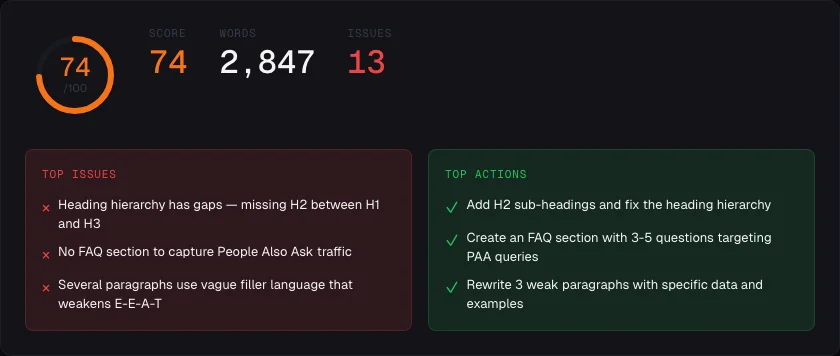
Score card output from a real content audit. It shows your overall Refresh Score, word count, issue count, and the exact actions to address each finding.
Looking for a lighter starting point for a single URL? Begin with the free content audit tool. Want to see the output first? Preview the sample audit report or use the content audit report template. Auditing blog posts specifically? Use the blog post analyzer. Need higher monthly volume for a repeatable solo workflow? See pricing. This page is the main overview of Page Refresh AI as your content audit workflow for one URL at a time.
A one-URL content audit is best when you already know which page needs work. Page Refresh AI reviews the visible content on that URL and turns structure gaps, missing answers, weak sections, internal-link gaps, and AI readability issues into an edit queue. It is not a replacement for a sitewide crawl or an analytics dashboard.
What Google and AI Search Reward Here
Google's current guidance still starts with helpful, reliable, people-first content. For AI Overviews and AI Mode, the same Search basics apply: crawlable text, snippet eligibility, visible main content, useful page experience, and structured data that matches the page. The GEO layer is practical, not magical: write direct sections that readers can use and AI systems can extract without guessing.
Page Traffic Qualification Gate
A page is more likely to earn durable search and AI-surface visibility when it passes the basics before adding more copy. Use this gate to decide whether one URL deserves a refresh, a technical fix, or consolidation into a stronger page.
Page Refresh AI helps with the content side of this gate after a URL is technically accessible. It does not replace crawlers, Search Console, analytics tools, rank tracking, backlink audits, or publishing systems.
Which URL Should You Audit First?
Do not start with a random page. A content audit is most useful when the URL already has a signal from Search Console, GA4, revenue importance, or editorial risk.
Choose the Right Audit Mode
Content audit is an overloaded phrase. Pick the mode based on the decision you need to make, not the label on the tool.
One public URL audit
Use when: You already know the page to review and need specific edit priorities.
Output: Structure gaps, missing answers, weak sections, internal links, and AI-readable answer checks.
Content inventory
Use when: You need to list many pages before deciding which ones deserve review.
Output: Spreadsheet fields such as URL, page type, owner, last update, traffic signal, and next action.
Technical site audit
Use when: You suspect crawl, rendering, indexing, redirect, performance, or template-level problems.
Output: Sitewide technical findings that should be handled before deep content editing.
Content Audit Software vs Sitewide Audit Platform
Content audit software can mean two different things. Some tools help teams manage a full content inventory. Page Refresh AI is narrower: it helps a solo blogger, freelancer, or small team inspect one chosen URL before editing it.
Use a sitewide platform when the job is inventory, ownership, or technical discovery. Use Page Refresh AI when the job is deciding what to change on one existing page.
Copy-Ready Content Audit Brief
Use this brief before running the audit or assigning refresh work. It keeps the review tied to one URL, one search job, and one measurable next action.
Turn the Audit Output Into the First Edit
A useful content audit does not end with a score. It should point to the first manual edit, the reason for that edit, and the follow-up check for the same URL.
This is why Page Refresh AI stays narrow: it turns one chosen public URL into an edit queue. It does not choose keywords, track rankings, audit backlinks, publish edits, or promise performance movement.
Use this page as the hub, then branch into the guide, checklist, and page-type audits.
What a Useful Content Audit Checks in 2026
A useful content audit is not just a word-count review. The page needs to satisfy the reader, be easy for Google to crawl, and contain direct sections that AI answer systems can summarize without guessing.
Reader intent fit
The page should answer the reason someone opened it, not only repeat the main topic. A useful audit checks whether the page answers the obvious next questions.
Extractable answer blocks
Definitions, comparisons, steps, and caveats should stand on their own. Clear sections are easier for readers, crawlers, and AI answer systems to interpret.
Evidence and update signals
Important claims need current examples, dates, screenshots, or source context. Stale references and unsupported statements are refresh candidates.
Internal next steps
A refreshed page should help the reader continue. Internal links to related guides, examples, pricing, or sample reports give both readers and crawlers a clearer path.
Manual Content Audit Workflow
If you do the audit by hand, use this order. It keeps the review tied to reader value before you spend time polishing copy.
- Confirm the page has one primary reader job and one clear next action.
- Compare the title, H1, intro, and first section against that reader job.
- Mark sections that are thin, stale, unsupported, duplicated, or hard to scan.
- List reader questions the page should answer before the CTA or next step.
- Check whether definitions, steps, tables, and caveats work as standalone answer blocks.
- Add internal links to the most useful related guide, sample, tool, or decision page.
How Page Refresh AI Builds the Edit Queue
The report reads one public URL and groups findings by what the editor can fix on the page. That makes it useful for solo bloggers, freelancers, and small content teams that need a page-level action list.
Page purpose
The report checks whether one public URL has a clear topic, audience, page type, and practical next step.
Content quality
It flags thin explanations, vague intros, stale examples, missing definitions, unsupported claims, and sections that do not help the reader decide what to do.
SEO structure
It reviews heading order, readable sections, internal links, and visible text patterns that affect crawlability and snippet quality.
GEO readiness
It checks whether important answers are extractable, entity names are explicit, and source context is clear enough for AI-search style summaries.
What the audit covers
Content Structure Audit
Evaluates heading hierarchy, section flow, and readability. Flags structures that make the page harder to scan, understand, and refresh.
Topic Coverage Gaps
Reviews the page against the questions a reader expects answered. Surfaces missing subtopics and follow-up answers that weaken answer completeness.
Thin Content Detection
Identifies paragraphs that add word count without adding value, including filler intros, redundant summaries, and vague claims, then suggests how to fix them.
Internal Link Audit
Finds related pages you may want to link to from the audited URL. Better internal linking improves crawl paths and gives readers useful next steps.
When This Is Not the Right Tool
Page Refresh AI is intentionally narrow. Use it after you have a URL to inspect, not when you need platform-level diagnostics.
- Use a crawler or Search Console when the question is whether many pages are indexed.
- Use a performance tool when the main issue is speed, JavaScript rendering, or Core Web Vitals.
- Use a content inventory when you do not know which URL deserves review yet.
- Use your CMS and analytics tools to publish edits, measure results, and compare post-update performance.
Content Audit FAQ
What is a one-URL content audit?
A one-URL content audit reviews a single public page for content structure, missing reader answers, thin sections, weak paragraphs, internal links, and AI-readable sections.
When should I use Page Refresh AI instead of a spreadsheet audit?
Use Page Refresh AI when you already know which public URL needs review and want page-level refresh recommendations. Use a spreadsheet when you need to inventory many pages before choosing what to inspect.
Does Page Refresh AI crawl an entire site?
No. Page Refresh AI audits one public URL at a time. It does not build a full-site inventory, monitor search movement, or manage a sitewide content calendar.
Can the audit improve AI search visibility?
The audit can surface issues that make a page harder to cite or summarize, such as unclear headings, missing definitions, and unsupported claims. Citations in Google AI Overviews, ChatGPT, or Perplexity depend on factors outside a single page audit.
What should I update first after the audit?
Start with the issues that block comprehension: unclear intent, missing definitions, stale examples, thin sections, weak intros, and missing internal links to related pages.
Ready to audit your content?
See how Page Refresh AI turns one public URL into a focused content audit with specific refresh priorities.
Audit your contentRelated Tools & Guides